A One-Hour Future Review for Your Personal Plans
A one-hour future review helps you spot what your personal plan needs next, set a clear checkpoint, and keep a useful option open without predicting outcomes.

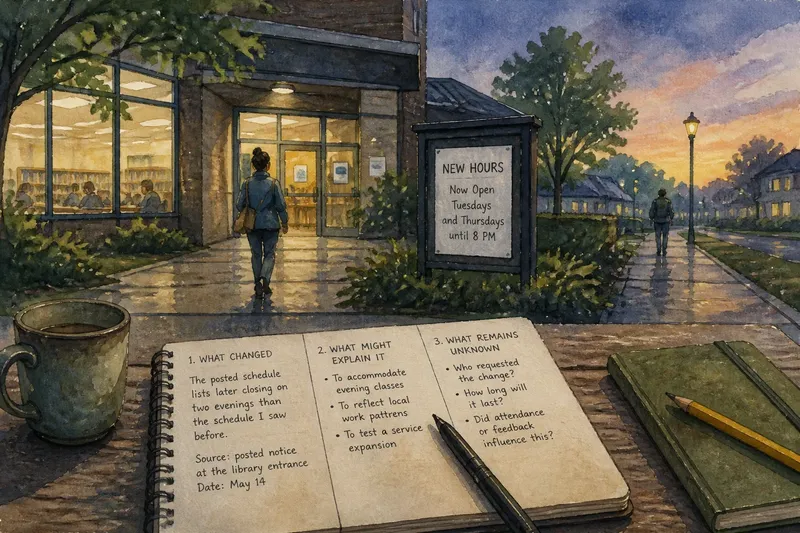
You open your calendar to check a plan for the coming months and notice that it rests on one quiet assumption: your work schedule will stay predictable. A one-hour future review can help you decide what to do with that specific plan, without turning your whole life into a forecasting exercise.
The useful difference is its boundary. You are not trying to list every possible future or build a backup for each one. You are checking whether this personal plan still deserves attention, what would count as a reason to pause or adjust it, and when you will make that call.
What makes a personal-plan review different?
A broad future-planning session can generate possibilities indefinitely. A bounded personal-plan review ends with a decision rule: a condition to watch, a point at which to revisit the plan, and a next action that fits your present situation.
Choose one plan and state it in a sentence, such as “I plan to take a training course” or “I want to move closer to family.” Then write the decision you actually face: start, continue, change, pause, or stop. That decision—not a catalog of possible futures—is the review’s center.
Choose the plan as it stands today, not as you hope it will look later.
How do you spend the hour?
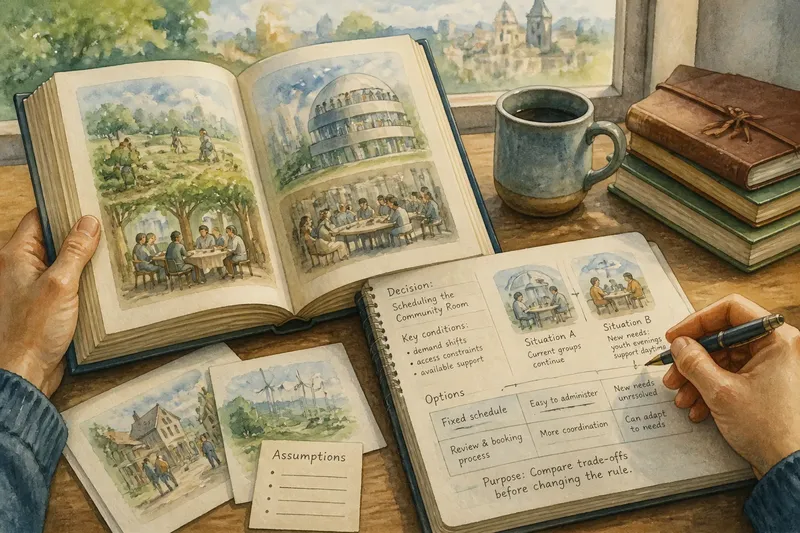
Use a kitchen timer and a notebook, notes app, or blank document. Divide the session into four blocks: define the decision, identify the condition that matters, set a review trigger, and write your next action. The aim is a usable note, not a complete account of your future.
- Define the decision. Write the plan and the next choice in plain language. If you cannot name a choice, narrow the plan until you can.
- Name a decision-sensitive condition. Complete “I would reconsider this plan if…” Choose something observable that could change whether the plan is worthwhile or feasible.
- Set a trigger and a time. Name what would make you look again and when you will check whether it has happened. Tie the check to a real event, such as a course enrollment decision or a conversation about household responsibilities.
- Choose one action for now. Pick an action that fits the current decision, such as asking a specific question or gathering a document. Avoid adding tasks merely to make the plan feel active.
Keep the page short enough to reread when the trigger arrives.
How do you choose a useful review trigger?
A trigger is a condition that tells you when the plan deserves another look. It is not a prediction that the condition will occur. Prefer something you can recognize—such as a schedule change, a response from another person, or a shift in your own priorities—over a vague instruction to “check in later.”
Use this simple decision check:
- If the condition is observable and would change your choice, write it as the trigger and decide what you would review; if it would not alter your choice, select a more relevant condition.
- If the condition is outside your control, name the event that would reveal its status; if no clear event is available, set a date to ask for an update or pause the decision.
- If the condition depends on your capacity, identify a concrete sign such as repeated schedule conflicts; if that sign appears, adjust the plan’s timing or workload rather than treating it as a character flaw.
- If the trigger is too broad, narrow it to one change that matters; if you cannot narrow it, write down the missing question and ask someone who can clarify it.
- If the trigger has already happened, review the plan now; if it has not, keep the current action small and wait for the stated checkpoint.
- If the plan has become draining or costly to maintain, check whether its purpose still matters to you; if it does, consider changing the route, and if it does not, consider pausing or ending the plan.
A good trigger helps you tell the difference between ordinary friction and a change that calls for a decision.
What questions help you keep the review bounded?
What should I do if the plan has no clear decision point?
Choose the nearest real choice, such as whether to gather information or make a commitment. If no choice is due, write one question you need answered and avoid expanding the review into unrelated goals.
What if the condition I care about is outside my control?
Write down the event or response that would clarify it, then decide what you can do while waiting. If there is no useful action, set a reasonable checkpoint and leave the plan alone until then.
How do I tell a meaningful change from routine variation?
Ask whether the change would alter your decision to start, continue, adjust, pause, or stop. If it would not change that choice, record it only if it helps you notice a pattern; otherwise, do not let it reopen the whole review.
When should I review the plan again?
Return to the note when its stated trigger occurs or when the related decision becomes due. If neither happens, you do not need to repeat the exercise on an arbitrary schedule.
What does a completed review look like?
Say you are considering a certificate course because you want more options at work. Your starting inputs are a plan to study on weeknights, an uncertain work schedule, and a course enrollment decision that is approaching. You have a notebook and can ask the course provider about class formats.
- Write the decision: “Should I enroll in this course now?”
- Name the condition: “I can attend if my work schedule leaves a regular evening free.”
- Set the trigger: “If my schedule changes before enrollment, I will ask whether the course offers asynchronous lessons.”
- Take the action: send the provider that question and note the reply beside the enrollment decision.
The resulting choice is conditional on the answer: if asynchronous lessons are available and fit your needs, compare that format with the scheduled classes; if they are not available and evenings remain unpredictable, defer enrollment or consider a shorter introductory option. This does not predict what your schedule will do. It gives you a clear decision to make when you have relevant information.
What should you write before you stop?
Close the review with three lines: the decision, the trigger that would make you revisit it, and the action you are taking now. Add when or where you expect to notice the trigger. Keep the note somewhere you can find when the decision comes up.
For a one-hour future review, make the checkpoint specific enough to change your next choice. The point is not to keep every option open forever; it is to spend attention when the plan gives you a reason to act, and let it rest when it does not.