The Straight-Line Future Trap
The straight-line future trap turns a visible trend into a forecast. Learn to spot turning points, interacting changes, and choices that can redirect its path.
A neighborhood grocery store gives more shelf space to plant-based meals, and a shopper wonders whether meat alternatives will keep expanding. That question captures the straight-line future trap: treating a visible trend as though its direction and pace must continue. A trend can point to a real shift without telling you what will sustain it, where it may stall, or what could bend it elsewhere.
The most useful response is not another broad forecast. It is to examine the trend’s mechanism: what makes it move, what limits it, and which other changes could alter the forces behind it. That keeps attention on the particular signal instead of turning uncertainty into a general planning exercise.
What does a straight-line forecast leave out?
A trend describes a direction of change, such as wider use of a tool or declining bus ridership in a particular area. A straight-line forecast extends that direction as if its causes will continue to operate in much the same way.
But the line alone cannot tell you whether its causes are durable. A bus route may lose riders because of temporary construction, a lasting shift in travel habits, or a service change that can be reversed. Those explanations imply different futures, even if the trend looks similar at first.
Before extending a line, pin down its scope. Ask which people, place, and behavior it describes, and what conditions produced the direction you see. A broad claim can hide differences between groups or locations that matter more than the overall pattern.
Use the line to ask a sharper question, not to answer one by itself.
What mechanisms can bend a trend?
Look for forces that change the trend’s underlying conditions. They may slow its pace, limit its reach, redirect it, or make the original signal less relevant.
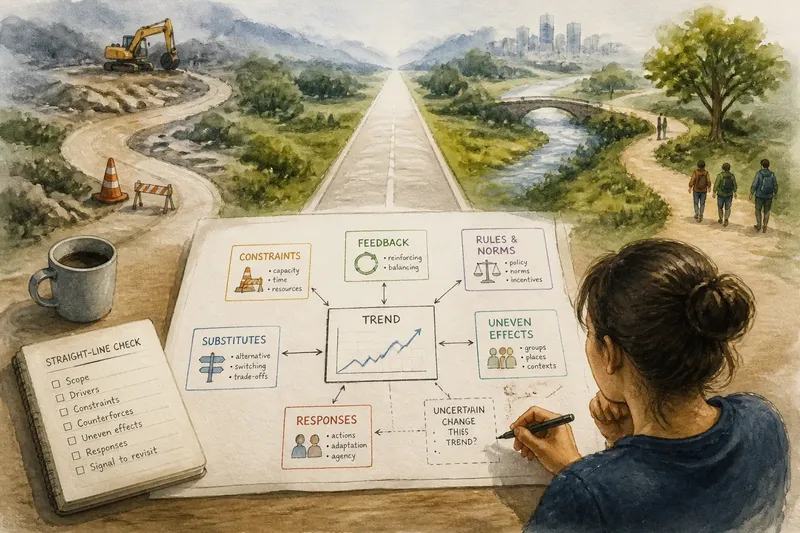
- Constraints: If supply, space, time, attention, or organizational capacity becomes a bottleneck, ask whether the trend can continue at the same pace; if not, consider a slower or narrower path.
- Feedback: If growth makes an option more useful, ask whether that benefit can reinforce further growth; if crowding or inconvenience grows instead, consider that it may curb adoption.
- Rules and norms: If policies or social expectations change the costs or convenience of an option, ask which group is affected; if the change is limited to one setting, avoid extending it to everyone.
- Substitutes: If another option meets the same need, ask whether people can switch; if they can, consider that demand may shift rather than continue along the original trend.
- Uneven effects: If the trend advances for some groups but not others, ask which group the signal represents; if the difference is substantial, describe the separate paths rather than relying on one broad line.
These mechanisms need not reverse a trend. A constraint might slow it, while a substitute changes who uses it. Ask what would have to remain true for the current direction to continue, then look for evidence that those conditions are changing.
How can other changes alter the trend?
A trend rarely operates alone. A change in work habits, for instance, may affect where people live, which can influence transport demand and the services a community supports. Consider the connection only where it has a clear mechanism; a map of every possible influence can obscure the signal you are trying to understand.
Draw the trend in the center of a page. Around it, write a few specific drivers and possible counterforces, then connect only the relationships you can explain. Mark uncertain links with a question mark. This makes the reasoning inspectable without pretending that a small map captures the whole future.
Say a library sees more visitors borrowing digital materials. Imagine staff add platform-help sessions, while a nearby community center changes its hours. The starting signal is rising digital borrowing; the actions are added support and changed access to another local service. The observable result to watch is whether borrowing keeps rising, levels off, or shifts among visitor groups. That result would show how this particular connection is developing, not settle what will happen elsewhere.
How do people alter the trend itself?
People respond to signals, and those responses can change the conditions that produced them. If an organization expects a resource shortage, it might conserve the resource, seek substitutes, or expand capacity. Each response could affect demand, access, or the shortage’s severity.
Include these reactions when you explain a trend. Ask who can act, what choices are realistically available, and who bears the effects. A forecast that leaves out likely responses may describe a path that decision-makers are already trying to change.
This is not a claim that any one person controls a large shift. It is a reminder that decisions are among the mechanisms shaping it. Distinguish actions that could influence the trend from conditions that are simply worth observing.
How can you test a straight-line projection?
Use this check on a specific trend before treating its extension as a reliable planning assumption. Each item pairs an observation with a decision and an alternative action.
- Scope: Check whether the trend names a particular behavior, group, and place. If those details are missing, narrow the claim; if they are clear, continue using that defined scope.
- Drivers: Check which conditions appear to support the direction. If a driver is only an assumption, label it as uncertain and seek a relevant signal; if it is observable, state how it could change.
- Constraints: Check for limits on supply, space, time, attention, or capacity. If a limit is already binding, consider a slower or restricted path; if it is not, keep it as a condition to watch.
- Counterforces: Check whether a substitute, rule change, or shifting norm could weaken the trend. If one is active, compare the trend with that alternative; if none is apparent, avoid treating that absence as proof of continuation.
- Uneven effects: Check whether different groups or places show different directions. If they do, describe those paths separately; if they do not, keep the claim within the population actually observed.
- Responses: Check what people or organizations may do in reaction to the trend. If a response could change its drivers, include that feedback; if no response is currently available, name the constraint instead of implying agency.
- Signal to revisit: Check which observable change would challenge the projection’s assumptions. If that change appears, revise the explanation; if it does not, retain the projection only as a conditional reference.
Imagine a town has seen fewer riders on one bus route, and a planner is considering whether to reduce its service. The starting inputs are the observed decline, temporary road construction, and a proposal to change the timetable. First, the planner checks the route and period covered, then separates the construction effect from any continuing change in travel habits. Next, the planner considers the proposed timetable as a possible response that could affect ridership, and chooses future route use after the road work as the signal to revisit the explanation. The resulting decision is not “ridership will keep falling”; it is “the decline may continue if the relevant conditions persist, but the construction and timetable changes could alter it.” The tradeoff is clear: acting on the line alone may miss a rebound, while waiting for every uncertainty to resolve may delay a service decision.
What do readers ask about straight-line forecasting?
Is a trend the same as a prediction?
No. A trend describes a direction in observed change, while a prediction makes a claim about what will happen. Extending a trend is one kind of prediction, conditional on its drivers and constraints continuing.
What is a turning point?
A turning point is a change in conditions that bends, stalls, or reverses a trend. It might be a new constraint, a different response, or several interacting changes.
Can a straight-line projection still help?
Yes, as a reference for what could follow if present conditions persist. Compare it with plausible alternatives and identify the conditions that would make each path more likely.
When should I revisit a trend projection?
Revisit it when a stated driver changes, a counterforce becomes active, or the signal you chose moves in an unexpected direction. For a consequential decision, set a review point suited to that decision rather than relying indefinitely on an old projection.
What should a trend-based decision say?
State the trend’s scope, the mechanisms that appear to drive it, and the conditions that could alter it. Then make clear which part of the decision rests on the projection and what observable change would prompt a revision. This keeps the claim proportional to the signal instead of presenting a conditional path as settled.
The straight-line future trap is not the act of extending a trend; it is mistaking the extension for the mechanism. When you revisit the straight-line future trap, look for the forces that could preserve the direction, the responses that could change it, and the people for whom the trend may not apply.