Before Forecasts, People Imagined Possible Worlds
Before forecasts, people imagined possible worlds to question social rules and explore alternatives; see how that practice developed into a tool for decisions.
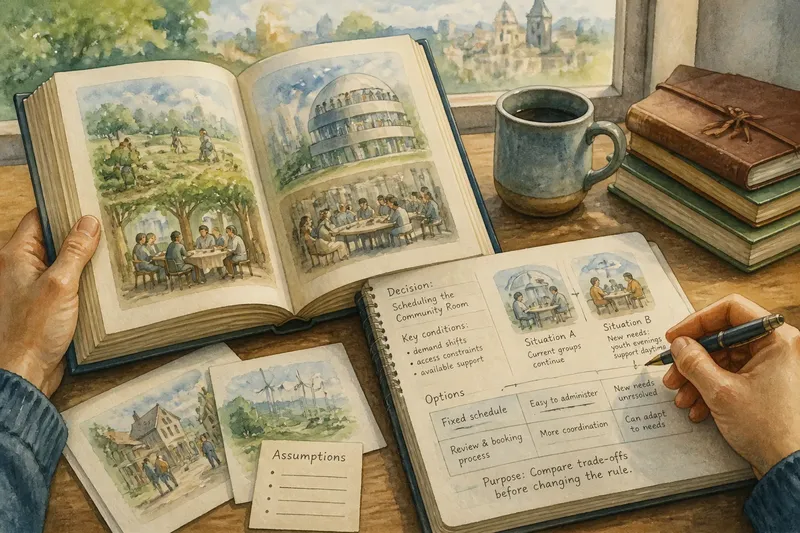
A reader opens a book and finds a society where familiar rules have been rearranged: property is shared, authority rests elsewhere, or daily work follows a different rhythm. Before forecasts, people imagined possible worlds in stories and arguments to examine such alternatives. Those works did not form one orderly stage before forecasting; they served different purposes in different places and periods.
The important connection is not a simple handoff from fiction to planning. Imagined societies could make customs and institutions easier to question. Scenario planning later gave the construction of alternatives an explicit organizational task: examine how a decision might fare under different conditions. The distinction helps explain both what these forms share and what they do differently.
What could an imagined society reveal?
A deliberately altered society makes ordinary arrangements look less inevitable. Change who owns land, who makes rules, or how people divide work, and a reader can ask who benefits from the existing arrangement and what its alternatives might cost.
These imagined settings have appeared in many kinds of writing, including political argument, satire, and fiction. Their purpose is not always to describe a future that could literally happen. An unfamiliar arrangement can instead sharpen a question about the author’s own society.
Read for the contrast: what has been changed, and what does that change make visible?
How did planning give imagined futures a different job?
Scenario planning did not simply turn stories into forecasts. It made the comparison of possible conditions a deliberate aid to a decision. A planning group begins with a choice it faces, identifies conditions that could affect it, and considers how the choice might work if those conditions differed.
This is a change in purpose, not a clean historical sequence in which imaginative writing stopped and formal planning began. Stories can still question social norms, and planners can still use narrative to make a possible situation understandable. What distinguishes a planning scenario is its connection to a specific decision and the assumptions that shape it.
For example, an organization considering a service change might ask how the change would work if demand shifted, access became harder for some users, or available support changed. The point is to make consequences discussable, not to announce which conditions will occur.
What changes when alternatives are structured?
Structure makes the reasoning behind a possible world easier to inspect. A planner names the conditions being considered, connects them to consequences, and asks what those consequences mean for the choice at hand. Without that connection, an elaborate future may be absorbing but not useful for deciding what to do.
Scenarios also need to differ in ways that matter. If two accounts lead to the same implications, the contrast may not help. If one depends on unrelated surprises, readers may have trouble tracing how its conditions affect the decision.
Imagine a neighborhood group deciding how to schedule a shared community room. Its starting point is a written rule that gives each group the same recurring time slot. The group drafts two invented situations: in one, the current groups continue to use the room at familiar times; in the other, a youth group asks for evening access while a local support group needs a quieter daytime slot. It lists the needs each situation creates, then compares the fixed schedule with a booking process that lets groups request and review time slots. The fixed schedule is easier to administer but leaves the new requests unresolved in the second situation; the review process takes more coordination but gives the group a way to adjust. The exercise does not predict who will attend. It shows the tradeoff the group should discuss before changing its rule.
How do imagined worlds differ from forecasts?
A forecast estimates an expected direction or outcome based on the question and information available. A scenario describes a possible set of conditions so people can examine what a decision would mean if circumstances differed. The two can inform each other, but they answer different questions.
A forecast asks what appears likely under its assumptions. Scenario planning asks how a choice holds up across alternative conditions. A forecast may be useful for a focused question with a reasonably stable pattern; scenarios can add perspective when consequential uncertainties could change what a decision requires.
Neither form removes uncertainty. Keep the distinction clear: a scenario is a way to reason about a possible situation, not a claim that it will come to pass.
How can you assess a scenario’s purpose and usefulness?
Start by identifying what kind of work the imagined future is meant to do. A story may invite reflection on values or institutions. A planning scenario should help examine a particular choice. Use the following checks to decide what to do next:
- Check whether the scenario names a decision; if it does, judge its usefulness against that choice, but if it does not, treat it as exploration rather than a decision tool.
- Check which assumptions create the imagined conditions; if they are stated, examine their consequences, but if they are hidden, ask the author or group to make them explicit before relying on the scenario.
- Check whether each consequence follows from a stated condition; if the link is clear, discuss what it means for the decision, but if it is unclear, revise the reasoning before comparing options.
- Check whether the scenarios differ in ways that affect the choice; if they do, compare what each option requires, but if they do not, change the conditions or use a simpler analysis.
- Check whether the account is presented as a possibility or a prediction; if it is clearly framed as a possibility, use it to explore implications, but if it is treated as certain, restate its uncertainty before acting on it.
- Check whether a change in conditions could prompt reconsideration; if a relevant sign can be identified, decide who will watch for it, but if none is available, record that the scenario offers no practical trigger for review.
Which questions help distinguish stories from planning scenarios?
Are imagined societies forecasts?
No. An imagined society may alter familiar customs to invite reflection, without claiming that its arrangement will occur. Read it for the questions raised by the contrast.
Does a planning scenario need to sound like a story?
No, but a clear account can help people follow how conditions affect a choice. The essential feature is the traceable connection between assumptions and consequences, not a literary style.
When is scenario planning a useful choice?
It can help when a consequential decision depends on conditions that may change in more than one meaningful way. For a narrow question with a stable pattern, a focused analysis or forecast may be enough.
Can a forecast and a scenario be used together?
Yes. A forecast can inform the assumptions in a scenario, while the scenario can prompt decision-makers to consider conditions beyond the forecast’s central account. Keep their distinct purposes visible when discussing the results.
Why does the history of imagining alternatives matter?
Imagining a different society and constructing a planning scenario share a basic move: both make alternatives easier to consider. Their purposes differ. One may expose how a social rule works; the other organizes assumptions and consequences around a choice.
That distinction makes the phrase “possible worlds” more useful, not less. Before forecasts, people imagined possible worlds to question arrangements they might otherwise take for granted; scenario planning gives that imaginative habit a practical role in decision-making. When you encounter an imagined future, ask what it is meant to help someone notice, question, or decide—and whether its claims match that purpose.